Tuesday 8th December: Podcast NEA Preparation

I have to go to the doctors first thing, so I'm going to be a little late this morning. Sorry.

Please make a start on the podcast/radio interview script; the last piece of work to complete our NEA. Examine the requirements below. If you have written your script, have a look at Adobe Audition, the software we are going to use to record, arrange and mix our interview.


When I arrive, you must be able to answer the following questions;
  1. Which of your magazine front page cover lines are you focusing on?
  2. Who will be the presenter?
  3. Who will be interviewed?
  4. Where will your second location be?
  5. Which social group will be represented?
See you in a bit!

Monday 30th November

This is your last opportunity to complete the final piece of NEA (advertorial) without having a penalty for missing a formal NEA deadline. Please make the most of your time this lesson as the deadline is tomorrow! All of your print-based NEA should have been submitted by the end of tomorrow. Good luck!

Next week, we will start to focus on the audio NEA. There is only a single task and it shouldn't take too long to complete.

24th November: Magazine Advertorial

Ok. your magazine double-page spread is due today. Please submit via Google Classroom (Please don't put me in a position where I have to penalise you for missing a formal NEA deadline).

You now have a week to complete and submit your magazine advertorial, again via Google Classroom. The deadline is Tuesday 1st December, meaning you have at least 100 mins today and 100 mins next Monday. You are, of course, encouraged to use your own time too.

Here are some resources to help you, making sure that you follow industry conventions. I will also post the NEA requirements. I will be online to support you between 9:15am and 10:30am during our lesson (use the live meeting link on our Google Classroom if you need help).


Helpful Resources

The Ultimate Guide to Advertorials

Examples of Advertorial Designs

The 14 Keys to Writing Advertorials That Sell


Remember that, by law, advertorials have to be easily identifiable as an advert and not just an editorial (story). You may include the word 'sponsored' or 'advertisement' in a prominent position to stay within the law. Alternatively, you may think that your advertorial is obviously an advert and not need additional labelling.


Exam Board Requirements


16th November: Magazine Double-Page Spread

Morning.

Your task for today's lesson is straigthforward; complete the Dream video annotation (and hand-in via Google Classroom) and work on your NEA (to make sure you meet the published deadline). You are, of course, welcome to work from home on your own machines. 

Currently, only Tyler has handed in his Dream annotation, so work on that first.

I will be online (see link on our Google Classroom) for the first hour if you need help or want me to check out your double-page spread.

Magazine Front Covers

 Thanks for submitting these before the deadline. Some massive improvements. Well done. See what you can do when the pressure is on!


10th November: Dream by Dizzee Rascal

TODAY IS THE DAY YOU MUST HAND IN YOUR FINAL VERSION OF THE MAGAZINE FRONT COVER VIA GOOGLE CLASSROOM. THERE WILL BE NO FURTHER EXTENSIONS FOR THIS PIECE OF NEA.

NOTICE

Unfortunately, I'm not in school today as I have to isolate until 2nd December. I'm really sorry about that and wish I could be there for you. However, because I blog our lessons and we have access to a Google Meet via Google Classroom, this won't stop us learning. The only difference is that you are allowed to work from home rather than attend the classroom.

UPDATE: Because so many of you can't access the live lesson, I've added recorded tutorials to the blog instead, so that you can work your way through today's lesson. However, I will be online between 9:30am and 11:00am to answer any questions or guide you through a review of your NEA work (or anything else you need). Just come online and join the lesson from our Google Classroom when you need me. Hope that works better for you?

EXPLAIN

I believe we are yet to cover our set text, Dream by Dizzee Rascal. You will need your copy of Adobe Premiere Pro downloaded and installed on your computer (from Adobe Creative Cloud) for this task. If you have an alternative video editor, you may use that too (including WeVideo on Chromebooks).

The first thing we must do, however, is to understand the information in the Dream Factsheet, identifying and highlighting the key facts. If you are using a physical copy of the factsheet, you can use a highlighter pen. If you are downloading the facsheet as a pdf, you can use the highlighting tool in  Kami. You will have 15 minutes to read the sheet and to highlight the key facts. Here is a link to a tutorial, showing you how to download the factsheet and annotate in Kami. 


MODEL

In this tutorial I will show you how to complete the following tasks using Adobe Premiere Pro;
  • Import a video
  • Insert a video into the timeline
  • Add text to a video
  • Slice a video to provide room for an inter-title
  • Export a video, selecting an appropriate format

Adobe Premier Pro Tutorials


PRACTISE

Now, to demonstrate your understanding of the Dream video, you should annotate a copy using all the key facts you have identified.

  1. Download the Dream video from our Google Classroom.
  2. Take the key facts from the factsheet and annotate the Dream Video using Adobe Premiere Pro.
  3. Use a combination of text overlays and inter-titles. Remember, the information must be on screen long enough for someone to read it!
  4. Once completed, export the edited video as a H.264 video.
  5. Hand in the annotated video via Google Classroom.
  6. Upload the annotated video to your Google Drive too
  7. Post hyperlinks to the Dream Factsheet and your annotated video on your online learning journal.
_____________________________________


NEA FINAL SUBMISSION (DOUBLE PAGE SPREAD)


MODELS OF EXCELLENCE

Here are some examples of double-page spreads from published magazines. Use these as models for your own submissions.


REQUIREMENTS

Firstly, let's just remind ourselves of the requirements set out by the exam board.


MODEL

Now let's remind ourselves of the definitions:


DRAFT NEA REVIEW

Now Let's consider your draft submissions. For each, let's consider the following questions. I've added some key questions under each of your individual submissions too.
  1. Have all the requirements been met?
  2. Does the product look authentic? Does it resemble the model images?
  3. What works well (so far)?
  4. What needs to be improved?
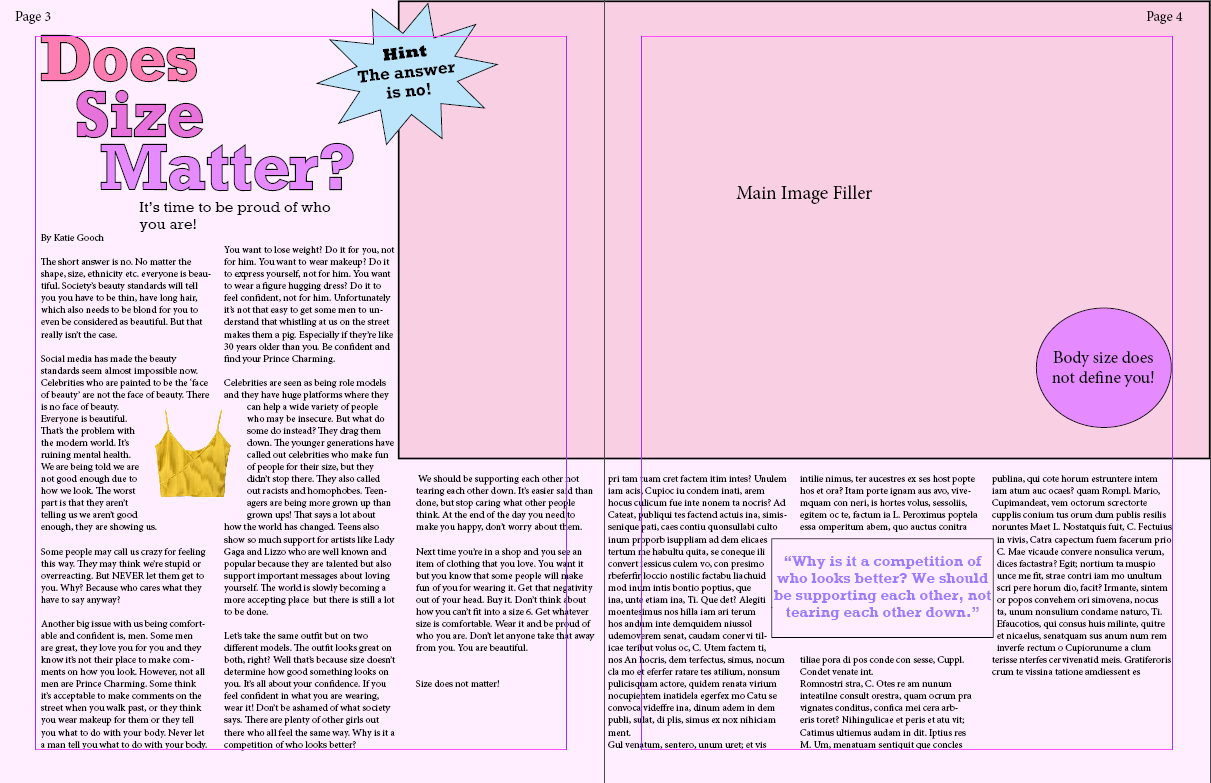
Wrote by? Pull-quotes? Font size & colour? Folio? By-line? Standfirst?

400 words? 2 smaller images? Standfirst? Gutters? Folio? Page No.? Website?

Folio? Web address? Magazine title? Bottom of page?

400 Words? Page No.? Website? Standfirst? Pull-Quotes?


Looking pretty good. Not sure about the positioning of the pull-quote on the left though. Can it be nudged right amongst the text a little? Might not look great but worth a try. What about the magazine web address in the white space at the bottom of the page too? Perhaps a couple of bits of page furniture too; a trendy short but thick line at the end of the copy or something similar?

You now have TWO weeks to complete your final double-page spread submission. This includes replacing Lorem Ipsum for original copy (you are assessed on the register you use; does it address the needs of your target audience?). You must also place images in all of your placeholders. Make sure you check your page against the list of requirements before handing in your final submission via Google Classroom.

You Owe Me!


All missing work must be completed by Monday 9th November. Failure to meet this deadline will result in the use of a Sixth Form Workplan (following a meeting with parents).

2nd Nov: My Magazine Front Cover Model

SMART START

How are women represented in the Kiss of the Vampire film poster?

Key terms you must use in your response;

  1. Represented
  2. Dress code
  3. Sexualised
  4. Gesture code
  5. Stereotypical / Stereotype
  6. Role Model
  7. Co-antagonist
  8. Damsel in distress
  9. Patriarchy (Patriarchal Society) / Matriarchy (Matriarchal Society)
Elements of the theoretical framework that you should reference;
  1. David Gauntlett's Identify Theory
  2. Liesbet Van Zoonen's Feminist Theory
  3. Bell hooks' Feminist Theory
Additional Challenge: See if you can incorporate the following elements of our theoretical framework;

    1. Claude Levi-Strauss' Structuralist Theory
    2. Stuart Hall's Theory of Representation
    3. Laura Mulvey's Male Gaze Theory
    I will present the KOTV film poster on the board, so the only tab you need open is your Google Document. Anyone found 'cheating' will be given an alternative question, a piece of paper and a pen (you've been warned).


    MODEL

    Here is a my magazine front cover model, showing how you can construct a simple front cover in about 30 minutes using a main image, some smaller images and a variety of fonts, font sizes and colours. In this case, the photography is original too.


    Just noticed I missed the cover price off. Doh! Imagine there's another text element just above the masthead that says £5.99 (or could have placed it by the barcode). Sorry! I've added it to the final export...


    Questions to ask yourself once you have constructed a magazine cover;
    1. Does it include all the required elements? (This is where I picked up my mistake!)
    2. Does the layout reflect magazine conventions?
    3. Are the proportional sizes of elements appropriate?
    4. Have you used a variety of fonts and font sizes?
    5. If there a recognisable house style?
    6. Does it look authentic? Could you imagine it on the shelf in WHSmith?
    Now we will provide peer-feedback on each of your magazine covers, considering each of these questions in turn. The feedback will be recorded. 

    You will then be asked to provide a grade using the following criteria;

    Meets the Requirements of the Brief

    1-2 : Includes only a small number of the brief requirements
    2-3 : Includes the majority of brief requirements
    3-4 : Includes all of the brief requirements but the layout is inappropriate
    5-6 : Includes all of the brief requirements and the layout is mostly appropriate
    7-8 : Includes all of the brief requirements and the layout is appropriate but the product lacks authenticity
    9-10 : Includes all of the brief requirements and the layout is totally convincing as an authentic product

    The Use of Media Language to Construct Meaning

    2 marks : The main image used is well-selected, well-framed and likely to attract an audience
    2 marks : There is a variety of font sizes and colours that represent the importance of articles within
    2 marks : The proportions of elements is appropriate, manipulating the audience's attention appropriately
    2 marks : Smaller images are well-selected, well-framed and likely to attract an audience
    2 marks : The strapline provides an appropriate clue as to the contents of the magazine and is likely to attrack an audience

    This will give you a total mark out of 20 for your magazine cover.


    After reviewing the feedback and grades you received, you will have one week to refine your magazine cover before next week's final submission.

    Here is a reminder of the NEA requirements;


    If you did not submit a draft submission of your magazine cover, you have today's lesson to complete it. You may use a stock images.

    13th October:

    SMART START

    How does Late Night Women's Hour support and/or challenge Curran and Seaton's Power and Media Industries Theory?

    Answer on a Google Doc and submit via our Google Classroom.

    REVIEW

    Please go back and review last week's Smart Start submission. Make changes to your answer, reflecting the feedback you were given.

    LEARNING CHECK

    Then complete this simple quiz, repeating it until you achieve 10/10.

    NEA

    Your magazine front covers are due today. You should now have submitted all of your NEA print products. Let's take a look...

    6th October: NEA Submission

    First things first... please make sure you have submitted your double-page spread. 

    SMART START

    Complete a Google Document for this smart start and submit via our Google Classroom.

    1. How does this print advert reinforce the conventions of other adverts from the 1950s?
    2. Review this advert with regard to Structualist Theory.
    3. Review this advert with regard to Identity Theory.
    4. Does this print advert reinforce or challenge the feminist theories we have studied?
    NEA Review (Double-Page Spread)

    Let's check your submissions against the requirements. As a group, we will then ask the following questions;
    1. Does the double-page spread look authentic?
    2. Have all the requirements been met?
    Here is a reminder of the requirements to each piece of NEA:


    Late Night Woman's Hour Revisited

    We will go through the fact sheet and the pages from the revision guides to make sure that we've covered everything. Find your post from early April (Late Night Woman's Hour) and add clarification and any further information.

    Resources


    AS Revision Guide, Pages 86 - 89

    A2 Revision Guide, Pages 108 & 109


    Remote Learning
    1. Make sure that you have read, understood and made notes about Late Night Woman's Hour. Your Smart Start question will probably be about LNWH next week!
    2. Complete and submit your next NEA submission (Magazine Front Cover).

    I'm back!

     I will be returning to school for your lesson next Tuesday (Hooray!). Please bring in evidence of your NEA work so far as I need to see where you are. Evidence could be printouts, screenshots on your blog, exported products... whatever.

    I look forward to seeing your work.

    8th September: Welcome Back

     Morning, welcome back! I'm afraid I can't be with you this morning. At this very moment, I am in hospital under the knife! However, you have variety of tasks you can engage with;

    • Make sure all 'lockdown learning' tasks are completed.
    • Continue with your NEA coursework.
    • Use the resources on the blog to revise all the media theories you should know, in preparation for a forthcoming test!
    I won't be in school for a couple of weeks, certainly not next week, so if you wish to stay at home next Tuesday to continue with NEA on your own computer, please feel free.

    16th July: Face-to-Face Lesson: 10:00 - 12:00

    SMART START

    How are representations constructed in this screengrab from Instagram? Complete the assignment on our Google Classroom. You have 15 minutes to construct a complete exam-style response.

    Megan Crabbe aka @BodyPosiPanda

    Some key questions to consider: To what extent does this represent traditional or progressive gender roles? To what extent does this challenge gender stereotypes?

    Some key terms to consider: Medium shot, low-angle shot, gesture code, stereotype, iconography, anchoring, mode of address, setting (there are other terms you should include too).

    Key theoretical framework theories to consider: Gender performativity (Judith Butler), Feminist Theory (bell hooks), Feminist Theory (Liesbet Van Zoonen), Identity Theory (David Gauntlett), Representation Theory (Stuart Hall), Structuralism (Claude Levi-Strauss)


    THE DOWNFALL OF ZOELLA & HER COMMERCIAL RESPONSE

    We will work our way through these updated exam board resources, making notes under a learning journal post entitled 'Zoella Update: Downfall & Commercial Response'.

    Task 1
    Oops! Page not found!

    Task 2
    Why Zoella Stopped Posting
    Independent Newspaper Article (Criticism of Zoella)
    Grazia Takes a Different View
    More Controversy
    Yet More Controversy
    Even More Controversy

    Task 3
    Zoella's Response to Dwindling Popularity

    Task 4
    A to Z Creatives

    Task 5
    Gender Roles in Tuesday Takeover

    Task 6
    Gender Representations Constructed Through the Zoella Instagram Pages

    Task 7
    Zoella Business Interests
    What is 'Commodification'?
    How Does Commodification Apply to Zoella / Zoe Sugg?
    Zoella YouTube Channel Analytics
    Zoella YouTube Channel: Life, Beauty & Chats
    Zoella YouTube Channel: More Zoella
    Glamour Cover

    Task 8
    Cordially Invited by Zoe Sugg
    Criticism of Cordially Invited

    Task 10 (I know I missed 9 - that's deliberate!)
    Zoella YouTube Task
    How YouTubers Really Make Their Millions

    Task 11
    Gleam
    What Does the Future Hold for Instagram Influencers?
    What Do We Know About Celebrity Endorsement in Advertising?


    THEORIES & THEORISTS REVIEW

    In today's lesson, I will show you how to make a 'Flappy'; a great physical resource for commiting the information relating to theories & theorists to long-term memory. I hope you are feeling 'crafty'?


    SUMMER WORK

    • Complete as much of your NEA magazine content as possible (not the front cover yet)
    • Make sure that you know all your media theorists (Theory / Theorist / Overview of Theory)
    • Get your online learning journal completely up-to-date! (so you can access year 13 work)
    • Work your way through the final aspect of the online media unit, Online Media Instrustry, using the resources below. Post your responses in a learning journal post entitled 'Online Media Industry'.

    25th June: Attitude; Representation

    For today's lesson you will need the following tabs open in your Chrome browser (so that you can switch between them);
    • Our Google Classroom page
    • Our Google Meets page (accessed via code in Google Classroom)
    • This blog
    • Your own blog (so that you can write directly into it during the lesson)


    STARTER

    Let's start with some revision, revisiting some of the learning from recent lessons. How much can you remember and recall? The revision is posted as an assignment in our Google Classroom.

    THE BIG PICTURE

    In today's lesson were are going to answer the following questions:
    1. How have representations of gender helped to shape society?
    2. Have how representations of gender changed over time?
    3. How are these repesentations challenged by Attitude? 

    EXPLAIN

    • Stuart Hall argues that stereotypes work by reducing characters to simplistic physical characteristics and behaviour traits.
    • Stuart Hall suggests that the media and the power of media representations play an important role in defining the ideological thinking of audiences regarding specific social groups (LGBT, ethnic minority, nationalities, regional identities, etc)
    • Stuart Hall argues that stereotyples reflect the power social groups have within society and, therefore, negative stereotypes reflect an inequality of power ('others')
    • Male homosexuality was only descriminalised in 1967.
    • The construction of gay 'otherness' was historically maintained by media representations that were either comic (limp wristed) or predatory (pervert).
    • Judith Butler presents the idea that gender is constructed through performance.
    • Judith Butler suggests that gender identities are fluid.
    • Judith Butler suggests that gender norms are established and policed by the media/society.

    We can listen to Judith Butler explain her theory in her own words...


    On your blog, put the title 'Attitude: Representation'. Post a summary of these theories, including the Judith Butler video.


    PRACTICE

    Examine this editorial from the Editor-in-Chief of Attitude magazine / website.


    Post and label (Attitude Editorial) a copy of the extract and then summarise the editor's (political) position in four or five bullet points. Try not to use direct quotations from the extract; try to paraphrase in your own words.


    Look at this extract from Attitude, featuring Jake Shears (Scissor Sisters).


    What sorts of representations of masculinity are constructed here? Does the image conform to any historical stereotypes? Also, consider how traditional representations are challenged. You may consider;
    • Body language
    • Costume design / make-up and the associated subversive connotations
    • Anchorage provided by cover lines and colour choices
    Present your ideas on this Jamboard. Use one 'sticker' per idea. Following the task, I will post a copy of the Jamboard on this blog. After the lesson, post a copy of the extract and a copy of your Jamboard.

    Back on your blog, answer the following question (5 minutes - if you are struggling, you can always raise your virtual hand!) Don't forget to post the question too!
    • How do the two Attitude extracts support Judith Butler's theory of Gender Performativity?
    Finally for today, look at these historic front covers of Attutide magazine.
    • How have the representations on these front covers changed over time? We'll have a short discussion, then you can post the question and a summary of your collective responses on your blog. Following the lesson, you can post some images from the article to support your argument (use captions to date images).

    TOMORROW'S LESSON & HOMEWORK
    • Post a copy of the Attutide extract (Jake Shears) and the collective responses (Jamboard).
    • Complete your review of representations on Attutide by visiting the Attitude website and seeking evidence to support both Stuart Hall's Theory of Representation and Judith Butler's Theory of Gender Performativity. Take screenshots and explain your evidence. Look for at least 3 examples of each theory.
    • Start a new post entitled '26th June: Zoella; Representation'.
    • Use this resource to complete a close analysis of the Zoella website, responding comprehensively to each question and task. You can post your work using any method you like; screenshots of resource, written Q&A, etc.
    • Update the learning journal monitoring document to reflect your progress.

    18th June: Live Lesson 2: Capturing and Keeping Online Audiences

    For today's lesson you will need the following tabs open in your Chrome browser (so that you can switch between them);
    • Our Google Classroom page
    • Our Google Meets page (accessed via code in Google Classroom)
    • This blog
    • Your own blog (so that you can write directly into it during the lesson)


    CHECK: Do you all have emojis / hands up extension?

    STARTER

    Revision of last week's lesson. Access the quiz posted as an assignment in our Google Classroom. All questions are based on last week's lesson and the reading you completed for homework. You will have 7 minutes to complete this quiz. We will go through your answers during the lesson.


    NEA NEWS

    Creative Cloud Licences
    LinkedInLearning

    EXPLAIN

    In the first part of today's lesson we will answer the following question;
    1. How do online media producers and capture and keep their audiences?
    To answer this single question, we will use this resource. After we have been through it, you can reveal the answers and screenshot the worksheet, posting it on your blog.


    The Rest of This Week's Lessons & Homework
    1. Read this article reviewing how Attitude (our set text) captures and maintains an audience. Post the article on your blog.
    2. Read this article reviewing how binary oppositions are constructed in online media. Post the article on your blog.
    3. Complete the analysis of this articule from Attitude, identifying the way binary oppositions are used to construct meaning. You can post your written reponse directly into your blog.

    11th June: Live Lesson: The Conventions of Vlogging

    For today's lesson you will need the following tabs open in your Chrome browser (so that you can switch between them);
    • Our Google Classroom page
    • Our Google Meets page (accessed via code in Google Classroom)
    • This blog
    • Your own blog (so that you can write directly into it during the lesson)


    STARTER: Quick Recall Test - Theories and theorists (2 mins)

    In today's lesson, we will answer the following questions;
    1. What are the conventions of a successful vlog?
    2. How is vlogging media language used to engage audiences?
    3. What media language is used to engage audiences in our set texts? (Zoella & Attitude)
    To answer question 1, we will examine the document below, addressing any unknown language and misconceptions. Once you are happy that you understand the text, you can screenshot and post the discussion directly into your learning journal.


    ______________________________

    To answer question 2, examine the techniques listed below and suggest a way in which it could be used to engage an audience. All of the answers are in the discussion document we have just reviewed. The first one has been done for you. We will work through this together; I will take responses from each of you in turn (you will be asked to turn your mic on). Present your responses in your learning journal (blog) using the following conventions.

    JUMP CUT : An editing technique that cuts material from single takes, giving the effect of jumping forward in time : Creates narrative energy by missing less important parts out of a final edit and is also suggestive of an amateur aesthetic.

    • BREAKING THE FOURTH WALL
    • UNSCRIPTED NARRATIVE
    • COLLABORATIVE CONTENT
    • AMATEUR AESTHETIC
    • EVERYDAY MISE-EN-SCENE
    • PRESENTER POV
    • HIGH-KEY LIGHTING
    • INVITATION INTO PRIVATE SPACES
    • NARRATIVE AUTHENTICITY
    • BEST FRIEND CHARACTERISATION
    • CONFESSIONAL NARRATIVE
    • CANDID IMAGERY
    • SANITISED STORY CONTENT
    • SINGLE CAMERA EDIT
    • NARRATIVE CURRENCY
    • CODES OF REALISM
    • ASPIRATIONAL NARRATIVES

    ______________________________

    To answer question 3, we will use the resource below to identify the media language in the extracts. Use the 'hints' button to define the media language if you need to and tick the correct answers. Use the online checking system to mark your response. For each extract, take a screenshot now and post in your learning journal after the lesson. Without switching your camera on, you should be able to present your computer screen to the rest of the class. We will take it in turns to present our screen and talk through the answers as we progress through the exercise. I will do the first one to demonstrate.

    Extract Analysis Task

    Homework

    Additional Reading:

    Online Media Text Book Extract (AS)
    Online Media Text Book Extract (A2)

    Also, use the 'Theory Presentations' page in the sidebar (NEW!) to revise any theories that you identified incorrectly in the starter task.

    NEA

    To finish today's lesson, if we have time, we'll have a brief discussion focusing on the progress you are making in terms of NEA. I will explain some thoughts I have about how you can complete the coursework using online editing tools.

    4th & 5th June

    I've marked you blogs and, apart from Katie, there's quite a bit missing. Please use these 3.5 hours over the next two days to catch up with everything that should be there but isn't. You also need to respond to the feedback I have left on some of your posts (see monitoring document).

    The NEA proposals I have read are really good; imaginative magazine titles especially. I am now expecting some high quality products from these ideas!

    Katie, you are at the stage where you need to start thinking about the specific content. What original photographs are you going to need to shoot? What will be your mode of address in the magazine? Formal or informal? What language / terminolody are you going to use? Remember, all photography must be original (not copies from the internet) but you can search appropriate internet images to use as model for framing, distance, focus, etc. Perhaps keep an archive of these models so that you are clear about what you are trying to achieve.

    Finally, just a reminder that next week's lesson will be live online at 9:00am on Thursday. I will post a Google Meet link on our Google Classroom just a few minutes before the lesson starts. Students are audio only, so don't worry about doing your hair boys!

    Live Lesson Update

    Unfortunately, we can't deliver live lessons yet as we need to establish some protocols and gather parental consent. Therefore, this week's lesson will be posted on the blog as normal and we will go for the 'live' lesson the following week. Thursday 11th June. Sorry.

    21st May: Podcast Preparation

    NEWSFLASH

    AT 9:00AM ON THURSDAY 4TH JUNE, DURING OUR NORMAL LESSON TIME, WE ARE GOING TO TRY A 'LIVE' LESSON USING WEBCAMS, ETC. LET ME KNOW IF YOU DON'T HAVE A DEVICE WITH A CAMERA THAT CAN ACCESS OUR GOOGLE CLASSROOM VIA GOOGLE CHROME. I CAN'T WAIT TO SEE YOU HAPPY SMILING FACES AND HEARING YOUR VOICES (TBH, IT WILL BE NICE TO HEAR ANY VOICE THAT DOESN'T BELONG TO MY WIFE OR DAUGHTER!). TO ACCESS THE LESSON, YOU SHOULD VISIT OUR GOOGLE CLASSROOM AND USE THE LINK THAT I WILL PUBLISH ON THERE (WILL BE PUBLISHED JUST A FEW MINUTES BEFORE THE LESSON).

    PODCAST PREPARATION

    The flatplans your print products that I have seen are looking good. Well done. If yours isn't finished, please finish it today before starting the podcast preparation.

    Now for the podcast. Remember, the podcast should present an interview with the creator of the magazine (the print product and the audio product are connected!). The creator is you, so you will have to be interviewed! Obviously, you will need to find somebody to play the part of the host.

    So, there are two ways to approach the podcast (audio product);
    1. Script the whole podcast episode
    2. Unscripted, but questions agreed beforehand
    Last year, when students wrote the script for the whole episode, we found that the outcome didn't feel natural; it didn't feel like a natural, flowing conversation (a convention of podcasts). Students who tried to improvise the whole thing had to complete a lot of editing to remove................. pauses (that was a joke that would have worked better face-to-face), stuttering, repetition and repetition (another joke that work have worked better in the classroom environment). I would suggest that the following preparation is likely to result in a high-quality, natural outcome;
    1. Outline the sequence of events / podcast structure (with timings)
    2. Write the questions to be used in each event / part of the structure
    3. As the interviewee (the person being interviewed) consider your responses to the questions, maybe noting some key words or terms that you would like to include, but don't write your responses out in full.
    Let me give you an example...

    Sequence of Events
    1. Jingle (0:05)
    2. Host welcome in studio (0:10)
    3. Host introduces guest (0:07)
    4. Studio interview part 1
    5. Introduction of location 2 (0:05)
    6. Location 2 interview
    7. Return to studio
    8. Studio interview part 2
    9. Thanks and future podcast promotion (0:15)
    10. Jingle (0: 10)
    Studio Interview Part 1 Questions
    1. How do you become the creator and editor of a successful, national magazine? What was your background and can you outline your journey?
    2. What aspect of the job is most challenging and which bits are most rewarding?
    3. Etc.
    Response to questions
    1. University degree / rival product job as journalist / blogging / podcasting / print
    2. Deadlines / financial planning. Meeting like-minded people / shared passion.
    3. Etc
    In today's lesson, you should prepare your podcast sequence of events and identify the questions you will ask in each section of the programme. Construct a blog post entitled "Podcast Preparation" and present your outline and questions.

    Look forward to 'seeing' you on 4th June!

    14th & 15th May: Print Product Detailed Flatplans

    Morning. Hope you are all fighting fit and happy!

    Today, we are going to start constructing our print products. You should have already identified a genre, magazine title, etc and now you should be ready to start constructing.

    The first stage in constructing a print product, particularly a magazine, is to product a flatplan. There are two types of flatplan, both of which are produced, in this order:

    1. Flatplan: Outlines the content of each page in the magazine so that you can see how the magazine 'flows' from one page to another.
    2. Detailed Flatplan: Outlines the content and layout of individual pages.
    Because we aren't constructing a whole magazine, we are going to focus on detailed flatplans. You can find information relating to flatplans below;


    I thought I'd also provide you with some further content guidance:


    Ok, hopefully you now have an idea of what a flatplan is and how it is used to plan and realise a great quality product. It is a vital stage in the construction of high-quality print products. You are going to need a flatplan for each of your magazine pages;
    1. Front Cover
    2. Double Page Article (remember to double the page measurements)
    3. Advertorial
    Before attempting to construct your flatplan, make sure you are clear on all the elements you must include (as identified in the brief). Make a list and tick them off as you include them in your flatplan.

    Front Cover
    • Masthead
    • Strapline
    • Cover price
    • Barcode
    • Main image
    • Additional images
    • Lead cover line
    • Additional cover lines (at least 3)
    Double Page Feature Article
    • Space for copy (approx. 400 words)
    • Headline
    • Standfirst
    • By-line
    • Sub-headings
    • Appropriate column layout
    • Main image
    • Additional, smaller images
    • At least 2 pull-quotes
    • Folio (magazine title & page number)
    Advertorial
    • Headline
    • Standfirst
    • Appropriate column layout
    • Images
    • Space for copy (150-200 words)
    I thought, rather than write a thousand more words, I'd give you a quick demonstration of how to construct a flatplan. Here is my attempt (I apologise for all the sniffing; I have a cold):
    WARNING: A MAGAZINE IS NOT A4! YOU WILL HAVE TO CUSTOMISE THE PAGE MEASUREMENTS!

    Once you've exported your flatplans as images, put them on your blog, clearly labelled so I know which page I am looking at. You have one week to complete ALL of your flatplans.

    Resources